Tag Archives: UF/IFAS

Jack Payne, AG TALK

Ann Blount is more proud of making friends than making discoveries. She’s made a lot of both.

The advances include a hand in the development of 76 forage cultivars and germplasms. A few friends, who know her as “Annie,” highlighted her discoveries to successfully make the case for Blount to be named Woman of the Year in Agriculture.

Those friends include Jim Handley, executive vice president of the Florida Cattlemen’s Association, and Nick Place dean of University of Florida Institute of Food and Agricultural Sciences Extension.

Blount is a forage breeder who has been with UF/IFAS for 30 years at the North Florida Research and Education Center in Quincy. Her greatest hit may be UF-Riata, a bahiagrass with a longer growing season.

It’s not only what she has achieved to help Florida ranchers inch closer to a year-round grazing season, but it’s also how she does it. Rancher input is an essential part of her research. If a rancher wonders aloud what would come of crossing two or three cultivars, Blount is off and running in her pickup, traversing the state to find seed for an experiment.

A producer far from Quincy once contacted her to ask if she’d come to take a look at his forage because it looked sick. Blount was passing through late at night, so that’s when she visited. She studied the grass by flashlight, identified the disease, and prescribed a course of action. Then she got back in the truck and kept driving.

Handley will tell you that watching grass grow doesn’t exactly capture widespread fascination. It does capture Blount’s. Producers come to Blount, Handley explains, because of her remarkable passion for pastures.

Having Blount show you her demonstration plots, Handley says, is like having an artist walk you through her gallery or a cowman take you for a ride to show off his herd.

I hear echoes of Norman Borlaug, the Nobel Peace Prize laureate and wheat breeder whose dying words were “Take it to the farmer,” when Blount talks about how she took the research off the center and took it to the end user. That’s you.

Blount says she’s now serving her third generation of producer clients and counts many of them as her close friends.

In his nomination letter, Handley wrote that Blount’s work has helped the cattle industry across the Southeastern United States.

She’ll be presented with the award during the 2019 Florida State Fair in Tampa in February. The recognition of Blount demonstrates the value of UF/IFAS science to Florida agriculture and of the friendships that accrue over a career of working among cattlemen and cattlewomen.

Jack Payne is the University of Florida’s senior vice president for agriculture and natural resources and leader of the Institute of Food and Agricultural Sciences.
Jack Payne, AG TALK

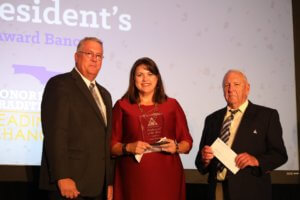
Libbie Johnson accepts the Extension Professional of the Year Award from FFB President Hoblick (far left) and Jimmie Cunningham, Escambia County Farm Bureau President

It was one of those Publisher’s Clearing House winner’s moments. When Libbie Johnson got a visit from Florida Farm Bureau President John Hoblick to inform her she was a winner, she shouted, “Shut up!” in disbelief.

John knew in advance that the force of Libbie’s personality is stronger than her will to contain it. So there was no telling what she might do when he told the University of Florida Institute of Food and Agricultural Sciences ag agent that she is the Florida Farm Bureau Extension Professional of the Year.

Escambia County Farm Bureau President Jimmy Cunningham nominated Libbie and cited her personality when asked what sets her apart from other agents. She uses direct language and colorful descriptions (she once said of another agent, “She could’ve tamed the West on her own and looked good doing it!”). She addresses people as “Brother” and “Friend.”

Of course, she does more than talk. Jimmy’s nomination has a long list of Farm Bureau activities that were made possible or better because of Libbie’s participation.

Libbie doesn’t have clients, she has friends. Early this year, she wrecked Sassy, her 14-year-old Toyota Tacoma that had logged plenty of its 330,000 miles visiting farms. Her first call was to Jimmy to come to get her. Then she called Farm Bureau Insurance, and they helped put her in another Tacoma.

For years, Libbie and Jimmy have been taking the story of local farmers to the community. Their Peanut Butter Challenge to collect jars for food pantries is a story about local peanut producers. Local Farm Bureau members supply Libbie with the five melons she signs with a Sharpie and presents annually to each county commissioner to tell the story of ag constituents.

Libbie doesn’t just want people to know about farms. She wants people to love them.

For Libbie and Jimmy, it’s important to have a young audience. Libbie wants kids to grow up to be leaders – leaders who appreciate what their constituents do to put food on tables. She’s not particular about the path the kids take to become leaders. She works just as hard to help with the Farm Bureau’s FFA events as she does to support Extension 4-H programs.

She’s been instrumental in establishing and maintaining the EscaRosa Young Farmers and Ranchers. That’s the under-35 set, and we all know it’s a crucial demographic to replenish a sector where the average age is in the upper 50s.

There’s another group of young people to whom Libbie tells the story of agriculture – young Extension agents. She wants to see more of them last the 15 years in a community that she has accrued in Escambia. Lesson one for rookie agents, she says, is to connect with your Farm Bureau board.

Farm Bureau leaders took her under their wing when she was new. They did it with grants for her programming. More importantly, they did it by including her in Farm Bureau events and projects. That helped form a bond that has attuned her to the needs of growers.

Libbie’s advice to young agents is sage. I hope our early career Extension faculty will take her up on it. In fact, Extension Dean Nick Place and I would like nothing better than to keep more of our agents, especially if they earn the Farm Bureau support that she has.

We recommend agents do as Libbie says – within reason. You probably should be sure as Libbie was that the answer will be yes if you’re calling a Farm Bureau leader for a ride if you wreck. And you better make sure it’s a sarcastic “Shut up!” if you’re talking to the state Farm Bureau president.

Jack Payne is the University of Florida’s senior vice president for agriculture and natural resources and leader of the Institute of Food and Agricultural Sciences.
Jack Payne, AG TALK

Aly Schortinghouse

[email protected]
@JackPayneIFAS

Ethan Carter had the two huge pines lifted off his home, put what he could salvage into storage, and moved in with relatives. Then, he started visiting farms.

The UF/IFAS Extension regional row crop agent based in Jackson County could not be accused of a lack of empathy. While his home took on further damage as rain poured in, he was documenting damage to fields, barns, equipment and homes to help farmers apply for relief.

Some asked him if what was left of their fields was worth harvesting. They asked if he had a guess as to what their post-Michael yield might be.

I’ll put our plant breeding up against anyone’s, but IFAS hasn’t developed cotton that stays on the bush in 150-mph winds. Until we do, we’ll have to do more hurricane response than prevention.

The strength of that response is in the statewide network of UF/IFAS Extension. When one area takes a hit, aid rushes in from neighboring counties.

A van full of agents from Escambia County rolled east toward the devastation. County Extension Director Nick Simmons and his team delivered hay. While they were there, they responded to call from a panicked producer whose cattle were escaping through his torn-up fence. They helped an agent cut her way through a barricade of fallen trees so she could join the relief efforts. Then they all crashed on air mattresses in a fellow agent’s living room so they could wake up on site and get at it again.

The hurricane revealed not only the scope of the Extension network but its versatility. Every agent was an ag agent doing damage assessment. Everyone was a livestock agent fixing fences.

Escambia 4-H agent Aly Schortinghouse became a chainsaw-wielding sawyer. Bay County agents Scott Jackson, Marjorie Moore and Paula Davis became 4-Hers of sorts. When they finished their days handing out supplies, they settled into bunks at 4-H Camp Timpoochee because they had no habitable homes to return to.

Meanwhile, Walton County Extension agent Laura Tiu reported to the Bay County office. People are used to going to Extension offices for help. A hurricane doesn’t change that. Tiu filled in while the Bay County staff went out to those who couldn’t come to them.

Escambia agent Libbie Johnson ran a laundry service for agents without power or water. She also pinch-hit for the agent who was supposed to run the UF/IFAS operation at the Sunbelt Ag Expo before Michael turned his life upside down.

Okaloosa agent Jennifer Bearden delivered a generator. She visited farms to do damage assessments. Jim Fletcher, a regional specialized water agent from Central Florida, came up to the Panhandle to fly a drone over farms to document the destruction with images. Doug Mayo turned the Jackson County Ag Center into a pet food and livestock feed center as well as a command post for directing volunteer fence repair crews to the ranches that needed them most.

As of this writing, we don’t know how long it will be until everyone gets utilities back and can sleep under their own repaired roofs. What we do know is that UF/IFAS Extension agents will keep doing what they always do – serving people who make their living off the land.

Jack Payne is the University of Florida’s senior vice president for agriculture and natural resources and leader of the Institute of Food and Agricultural Sciences.

Jack Payne, AG TALK

[email protected]
@JackPayneIFAS

Twenty years ago, the Florida Automated Weather Network launched on the premise that weather information from the airport isn’t enough for those in distant rural areas whose livelihoods depend on dew points and wind speed.

University of Florida Institute of Food and Agricultural Sciences Extension has long recognized that perhaps no one relies on this information more than farmers do. So UF/IFAS Extension brought weather stations closer to the farm.

Today, Extension has 42 weather stations on public lands in rural areas to take the temperature of your region.

Then, Extension brought the weather stations right onto your farms. In the past five years, Extension has installed 200 weather stations on private farms, ranches and groves. That means we can give you readings on rainfall in your neighborhood.

For example, there’s one on the Florida Strawberry Growers Association farm in Dover, which serves as a research and demonstration farm for UF/IFAS strawberry scientists.

We don’t do this alone. In addition to station hosts such as the FSGA, the Florida Department of Agriculture and Consumer Services and the state’s water management districts partner with us.

The Farm Bureau has been a valued past financial supporter and continues to testify to FAWN’s importance when it’s time to renew state funding. And Farm Bureau members and leaders such as Kenneth Parker graciously make space available on their land to host stations.

We’re looking ahead to the prospect of delivering data so local that you can consider your farm its own microclimate. UF/IFAS forecasts that someday your smartphone will essentially give you a weather map of the row you’re working.

The technological challenge is how to harness the growing mountain of data. FAWN measures dozens of weather indicators every 15 minutes 24/7. We’ll need to combine the right pieces of that data with information from other sources such as the National Weather Service to make FAWN even more useful.

Fortunately, that’s just what UF/IFAS research and Extension do. We deliver discovery to you in usable form. Kati Migliaccio, the new chair of the UF/IFAS Department of Agricultural and Biological Engineering, uses FAWN data to drive the phone apps she developed to help producers of avocados, citrus, cotton, strawberries and turf decide when and how much to irrigate.

Before a forecasted freeze, citrus agent Chris Oswalt makes the rounds collecting leaves from groves and feeding the information into FAWN to help growers make freeze protection decisions. Natalia Peres and Clyde Fraisse use FAWN temperature, relative humidity, rainfall, wind speed, and solar radiation data to estimate the risk of strawberry disease and to inform growers on the need to spray fungicide for protecting their crops.

The information can be just as valuable after the fact. We had a spike in FAWN use after Hurricane Irma as producers sought to document for relief agencies just what had hit their crops those fateful few days last September.

We’re in hurricane season again, when everyone, not just farmers, pays a little more attention to the weather. FAWN pays attention all year. Individual agents occasionally go on vacation, but Extension never does.

The future of FAWN includes other parts of UF, not just IFAS, gleaning useful grower data. For example, faculty with the UF College of Law is talking with FAWN director Rick Lusher about how you can use FAWN data to determine how to limit your employees’ vulnerability to heat stress.

Extension brings UF to you. Usually, it ’s IFAS that has your solutions, but Extension finds what you need among UF’s 16 colleges and thousands of faculty members.

The spread of UF/IFAS FAWN stations means you can

carry us around with you in your hip pocket. Extension meets you where you are. If you’re like most people, that’s increasingly in your smartphone. It’s part of our 24/7 commitment to production agriculture.

Jack Payne is the University of Florida’s senior vice president for agriculture and natural resources and leader of the Institute of Food and Agricultural Sciences.

Jack Payne, AG TALK

Jack Payne

[email protected]
@JackPayneIFAS

Just by participating in one of our research projects, Farm Bureau members recently gave the University of Florida’s Institute of Food and Agricultural Sciences the highest compliment I can think of.

You trust us.

That’s the takeaway from a recent survey done by the UF/IFAS Center for Public Issues Education in Agriculture and Natural Resources, or PIE Center. We’ve often described ourselves as trustworthy, but to my knowledge, we’d never actually measured it.

So in a way, the PIE Center’s work was our way of acting on the old Ronald Reagan dictum, “Trust but verify.” We apply it to our science, and we apply it ourselves.

The PIE Center’s Ricky Telg asked you to rate the trustworthiness of about 20 sources of information, and UF/IFAS came out on top. Not only that, but our strongest competition for trustworthiness is ourselves.

The local UF/IFAS Extension office, UF/IFAS and the PIE Center are three of the top four highest-rated sources. We didn’t specify the other one in the top four, “agricultural specialists,” as UF/IFAS faculty, but many could interpret that as a UF/IFAS function.

After UF/IFAS come federal and state agriculture and natural resource organizations and agencies. On the least trustworthy end of the spectrum were various sources of news media and social media.

Trust is the gold standard when your mission is to provide information. It’s also key to a strong relationship that helps UF/IFAS to help Florida’s production agriculture thrive.

We didn’t do this to produce a feel-good report. We did it because trust is an essential element of good science.

We need to repeatedly prove we’re trustworthy to get the access we need to do trials on your farms. We need it so you will be candid with our Extension agents and researchers. We need it so you’ll support the research agenda we devise to support you.

Our soaring university rankings aren’t in themselves what makes us an authority on solutions to your challenges. Trust is. The ratings and rankings are the result of your trust in us, not the cause of it.

Of course, the job of earning your trust is never done. Instead of just accepting it as a given that you hold us in high esteem, we used scientific surveying methods to quantify and challenge it.

We’ll never stop working to be worthy of the trust you place in us.

When you turn to UF/IFAS, what you’ll hear from us is going to be based on data, observation, experimentation, and science – the best tools we have to establish the truth as we know it. It’s been that way since UF/IFAS was established 54 years ago, and it’s not going to change.

Trust me.

Jack Payne is the University of Florida’s senior vice president for agriculture and natural resources and leader of the Institute of Food and Agricultural Sciences.