Frank Watts of Jacksonville dedicated his life to helping people understand the importance of the ground beneath their feet. Through decades of leadership and scientific contributions, he helped shape how Florida studies, maps and values its soils, a legacy that will continue to enrich the state for generations to come.
Raised on a six-acre farm in western Kentucky, Watts was introduced to agriculture early through his father, who worked as a county Extension agent. He was heavily involved in FFA, earning the State FFA Degree in 1962. It was an FFA teacher who first introduced him to soil science, which would become his lifelong passion.
Watts earned his bachelor’s degree from Murray State College and a master’s degree from Murray State University before continuing his academic journey with an assistantship in soil science at the University of Missouri and advanced studies at Cornell University in 1976.
He began his 42-year career with the U.S. Department of Agriculture in Kentucky, working with Plant Pest Control, the Mark Twain National Forest in Missouri and the Soil Conservation Service (now the National Resources Conservation Service).
In 1970, Watts transferred to Florida, where he served as a soil project leader. He planned soil surveys, guided teams of soil scientists, coordinated with local and federal agencies and ensured scientific accuracy in every project.
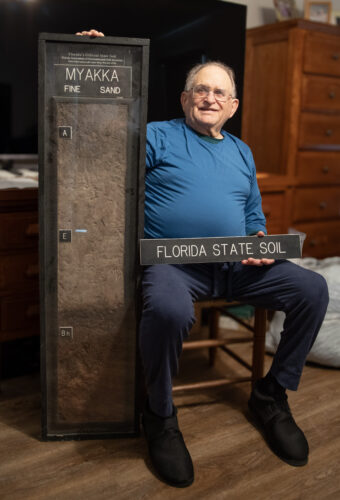
Watts was instrumental in developing the official guidelines used to determine whether a soil is considered hydric–meaning it has wetland characteristics– and in establishing how those soils are mapped in the field. His scholarly contributions include two articles in Soil Survey Horizons: “History of Establishing a State Soil: Florida’s Myakka Fine Sand” and “Determining Depths to the Seasonal High Water Table and Hydric Soils in Florida.”
Among his proudest achievements was co-authoring “Soils of Florida”, a comprehensive book that compiles 30 years of work by soil scientists across the state. The book showcases the diversity of Florida’s soils through detailed profiles and photographs- many of which had sat unused in a library for decades. “I had slides of all of those pictures, and they were just going to waste,” Watts said. “I had to get them out.”
Watts served as president of the Florida Association of Professional Soil Classifiers (now the Florida Association of Environmental Soil Scientists). In this role, he successfully led the effort to designate Myakka fine sand as Florida’s official state soil in 1989, drawing attention to the vital role that soils play in food production, water quality and the environment. “Other states were beginning to designate state soils,” Watts said. “Florida didn’t have one. I said, ‘by golly, we’re going to get one!’”
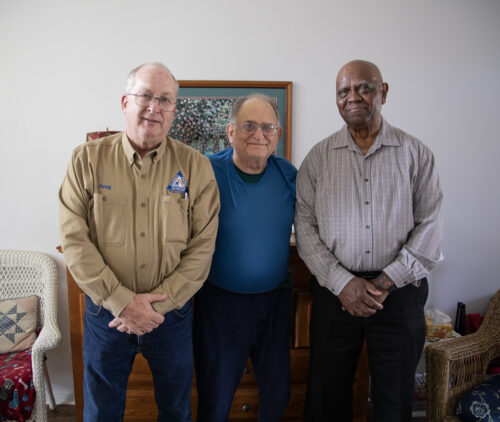
Duval County Farm Bureau President Greg Tison, whose USDA career intersected with Watts’ work, witnessed that passion firsthand. “Back then, they dubbed him the nickname ‘Mr. Myakka’,” Tison said- a reflection of Watts’ expertise and the pride he took in promoting Florida’s soils.
Retirement in 2003 didn’t slow Watts down. He continued teaching future generations through 4-H and FFA land-judging contests, helping young people see soils not as dirt, but as critical components in responsible land-use decisions.
In 2025, Watts received the inaugural Unique Service to Agriculture and the Environment award from the Jacksonville-Duval County Agricultural Council. Created by Tison and retired district conservationist Allen Moore, the award is reserved for truly exceptional service and is not intended to be given annually- a testament to Watts’ impact.
“We needed to recognize Frank for his contributions,” Tison said. “From where this house is sitting to the roads you drive on, nothing is built without people who know about soils.”
Soil science research influences everything from construction and land–use planning to agriculture and environmental protection. “Soils don’t end at the farm boundary,” Moore said, and thanks to Watts, neither does our understanding of them.