Tag Archives: J. Scott Angle

Your Land Grant Partner

November 2023 FloridAgriculture eNewsletter
dr angleBy J. Scott Angle
[email protected]
@IFAS_VP

On June 16, 2020, UF/IFAS agronomist and longtime Gadsden County Farm Bureau member David Wright sent a text that doctors had found a golf-ball-sized tumor in his head. Colleague Sheeja George asked how she could help.

“Keep the crew going,” David responded.

George and colleagues revered David for his work ethic, his humility, and his love for agriculture. He had 10 kids and 10 tractors at his family farm in Quincy.

David’s 45-year career at the North Florida Research and Education Center in Quincy contributed to the understanding and adoption of what some call conservation farming. That is, he researched and taught producers about sod-based rotation and crop-livestock integration. It produces better yields and better environmental stewardship.

“We would be hard pressed to find a farm in North Florida that Dr. Wright’s shadow has not been on and had a positive effect on it,” wrote the Farm Bureau leaders in Gadsden, Calhoun, Jackson and Santa Rosa counties who nominated David for the Extension Professional of the Year Award.

And this compliment is recorded in a memory book at David’s retirement: “You don’t really ‘deliver’ a solution; you partner with many and ‘design’ them knowing that there is a human at the other end who is receiving and using it.”

Isn’t that what Extension is at its best?
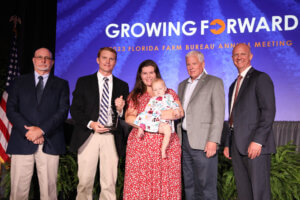
David was cherished as a man as well as a scientist, so it’s very meaningful to us at UF/IFAS that the Florida Farm Bureau spotlighted Wright’s legacy by posthumously honoring him last month in Orlando. And it was meaningful to David that the Farm Bureau told him about the award before his death in July.

David recognized that science is in part a social phenomenon. In addition to hypotheses, observation and measurement, it depends on trust.

He built that connection and credibility with a question to colleagues: “Do you want to walk a few rounds?” The walk-and-talks around a pond at NFREC explored scientific challenges and built camaraderie.

The line between work and family was thin at best. Most of his kids have helped out at NFREC in some capacity. He considered clients to be friends and would knock on their doors, call them after hours and get to know their spouses and children.

He shared information with scientists nationwide that helped control soybean rust when it first hit the U.S. He also emphasized shared bonds, like when he gave a lobster hat to a departing USDA colleague who was moving to Maine, or when he helped a graduate student find funds to visit his family in Ghana.

David called me as his health deteriorated, and he urged me to start looking for a successor so that important science would not be interrupted. I think it was his way of telling me, “Keep the crew going!”

J. Scott Angle is the University of Florida’s Interim Provost. Since 2020 he has served as UF’s Senior Vice President for Agriculture and Natural Resources and leader of the UF Institute of Food and Agricultural Sciences (UF/IFAS).


Your Land Grant Partner

October 2023 FloridAgriculture eNewsletter

dr angleBy J. Scott Angle
[email protected]
@IFAS_VP

When the Florida Farm Bureau Federation and UF/IFAS work together, we can help a youth from Live Oak develop into a voice for farmers and ranchers nationwide.

John Walt Boatright has returned the favor with years of service to both our organizations.

In fact, he started serving while he was still a student at the UF/IFAS College of Agricultural and Life Sciences (CALS). As a CALS ambassador, Boatright was the student speaker at our first Dinner of Distinction in 2012.

It’s our annual event honoring our staunchest supporters. Boatright has attended nearly all of them.

UF/IFAS Advancement’s Dinner of Distinction 2023. Photo taken 09-15-23

Boatright got to the podium again this year. This time he was silent as someone else spoke. Dean Elaine Turner told an audience of hundreds, “We are proud to have a part in his story through college and beyond,” before announcing Boatright as the recipient of the 2023 CALS Alumni and Friends Horizon Award for outstanding contributions to the College.

On the path from student speaker to guest of honor, Boatright established himself as a leading voice for agriculture policy. During his five and a half years in Gainesville, he regularly shared insights from his job as your FFBF director of national affairs with our faculty and students.

In fact, Boatright says, he understood that sharing those insights with UF/IFAS to be part of his job. He was told a major part of the reason FFBF headquarters is in Gainesville is to be close to UF, IFAS and CALS.

His sharing has taken many forms. Boatright served on the UF/IFAS Department of Agronomys industry advisory committee as well as on the Leadership Council for the UF/IFAS Department of Food and Resource Economics (FRE), his academic home as an undergraduate. He has spoken at every FRE Agricultural Policy Outlook Conference since his start at FFBF.

He’s been a repeat volunteer for CALS “Coffee and Careers” events on campus at which he meets with current undergraduates to review resumes and talk about his path from undergraduate to national leader.

CALS and FFBF both helped him along that path. Boatright acknowledges current FRE Chair Lisa House, who was his agribusiness management instructor a decade ago. FRE’s Mike Olexa taught him agricultural law.

Then-FFBF assistant to the president Kevin Morgan helped Boatright find just the right place in the organization. And Boatright’s former boss Jaime Jerrels mentored him in the policy arena.

So, it all seemed a bit surreal to Boatright to be held up as an honoree with his double-Gator Dad and House and Morgan in the audience, a dean handing him an award, a photographer documenting the moment, and this year’s CALS ambassadors greeting him.

As an FFBF professional and CALS Ambassador alumnus, Boatright has connected our two organizations in many ways, including speaking at meetings of the UF chapter of Collegiate Farm Bureau. It’s yet another way UF/IFAS and FFBF are growing Florida’s future.

Boatright wouldn’t be who he is and where he is if not for both our organizations. We thanked him for the decade he’s spent thanking us with his service.

Scott Angle is the University of Florida’s Interim Provost. Since 2020 he has served as UF’s Senior Vice President for Agriculture and Natural Resources and leader of the UF Institute of Food and Agricultural Sciences (UF/IFAS).


Your Land Grant Partner

September 2023 FloridAgriculture eNewsletter

dr angleBy J. Scott Angle
[email protected]
@IFAS_VP

It was music to my ears to hear District 17 State Director Mark Sodders talk about how UF/IFAS keeps him in business. It was comedy to hear District 5 State Director Rod Land say of Lafayette County: “That’s where you go when you die… if you’re good!”

And it was poetry to hear President Jeb Smith talk about the strong bonds between UF/IFAS and the Florida Farm Bureau.

I’m proud to serve the university as interim provost, but as I told the gathering at the Extension Professional Associations of Florida annual Farm Bureau appreciation dinner last month, I’m eager to get back to leading UF/IFAS full time.

It’s not like I needed a reminder of why, but the dinner at the Alachua County Extension Office in Newberry reconnected me with friends new and old and drove home the sense of community and kinship I feel with Farm Bureau folks.

From Jeb’s bear hug to talking fertilizer with Mark to meeting a number of the Farm Bureau’s communiGators—the corps of recent UF grads who help Rachael Smith tell the Florida ag story, I felt at home.
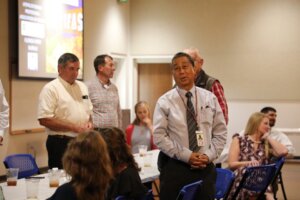
I was enthused by District 19 State Director Mark Wilson’s interest in artificial intelligence in agriculture. Women’s Leadership Committee Chair Danielle Daum prompted an important discussion about broadening our thinking about qualifications as we recruit professionals for Extension positions.

It’s going to be tougher to escape the administration building unnoticed if I do an overnight in Orlando rather than just an after-hours local visit like the one in Newberry. Still, I hope to see you all at the annual meeting at the Caribe Royale.

It’ll be worth the trip just to see you honor the Extension Professional of the Year. But I know it will also include the mix of music, comedy and poetry I’ve come to expect from visits with FFBF, that sense of kinship and community.
I work for you. Thanks for making it feel like a family business.

Scott Angle is the University of Florida’s Interim Provost. Since 2020 he has served as UF’s Senior Vice President for Agriculture and Natural Resources and leader of the UF Institute of Food and Agricultural Sciences (UF/IFAS).

Land Grant Partner

August 2023 FloridAgriculture eNewsletter

dr angleBy J. Scott Angle
[email protected]
@IFAS_VP

Thanks in part to Farm Bureau support for our legislative agenda, UF/IFAS plans to expand its enrollment in equine programs by 10 percent.

This will prepare more students for work in farm management, pharmaceutical and feed sales, equine business marketing or to apply for veterinary school or other advanced degrees. It means more hands-on, experiential learning.

The funding means we can begin to lift limitations we’ve had on instruction in how to take care of the animals that help take care of your animals because the “classroom” had slipped into disrepair.

The state will fund nearly $2 million for a new building and assorted repairs to the UF/IFAS Horse Teaching Unit, aka the HTU.

The current facilities become unusable when rain floods the property. Classes get canceled, research gets disrupted. Holes, unsafe wiring and fire hazards threaten the safety of animals and humans alike.

During the winter, Florida has more horses than Kentucky. Yet there’s nowhere else in the entire Florida public university system I know of where a student can take Techniques in Farrier Science or live at a stable to take on 24/7 care of these valuable animals.

So the upgrade of the HTU is important not only to support the huge economic impact of equine competitions and tourism but of training your future professionals.

This is not a case of remedying neglect. We’ve stretched the resources we have as far as they’ll go.

I’d like to single out the outstanding job that Angela Chandler has done. She’s so good at managing the HTU that when the director of our Equine Sciences Center in Ocala retired, we gave Chandler a second job and used the savings to, among other things, pay for needed repairs.

Chandler (who is quick to credit Joel McQuagge and Saundra TenBroeck for building the program) also boosted hay production at the Ocala center, reducing feed costs at the equine and beef units. She’s saved money through equipment sharing, and she’s built a reputation for the HTU that has the potential to generate revenue through standing outside stallions.

Indeed, last year the university recognized her among its tens of thousands of employees statewide with one of its eight Superior Accomplishment Awards.

The Farm Bureau’s annual day in Tallahassee did a lot to educate policy makers about the need. Now that we have some of the resources to address it, I hope you’ll join me in thanking Representative Josie Tomkow and Senator Dennis Baxley for sponsoring the legislation to authorize the funding.

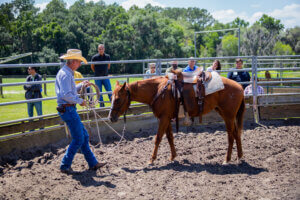
Joel McQuagge training a horse in a demonstration at the Horse Teaching Unit. Photo taken 05-15-19  

UF/IFAS is also launching a fundraising campaign to build an endowment to support the equine program, a critical component of its long-term success. If you’re interested in naming rights or other opportunities to support the program, please contact Julie Conn at [email protected].

With all the technology we’re bringing you to reduce manual labor and better inform your management decisions, we can’t outright replace the horse.

That four-legged tool is only as effective as its operator, though. The HTU is how we transmit the know-how for you to get the most out of your horses and ensure they get the same care your cattle receive on your ranch.

As the HTU improves, so does the student experience, and so does the quality of the graduates you hire.

Scott Angle is the University of Florida’s Interim Provost and will return as Senior Vice President for Agriculture and Natural Resources and leader of the UF Institute of Food and Agricultural Sciences (UF/IFAS).


Your Land Grant Partner

July 2023 FloridAgriculture eNewsletter

dr angleBy J. Scott Angle
[email protected]
@IFAS_VP

When Florida agriculture and UF/IFAS identified a sudden and emergency need to update nutrient rate recommendations, we turned to a longstanding relationship—Farm Bureau members and UF/IFAS scientists.

The Farm Bureau leader is Ben Wells, vice president of the Putnam/St. Johns County Farm Bureau. The team of UF/IFAS scientists includes Christian Christensen, Lincoln Zotarelli, Lakesh Sharma, Kelly Morgan, David Liu, Tom Obreza, and others.

We never intended for our recommendations—some of which are decades old—to become regulations. But that’s where we are. So we’re doing the research on how much fertilizer goes on crops that include potatoes, tomatoes, citrus, corn, green beans, and more.

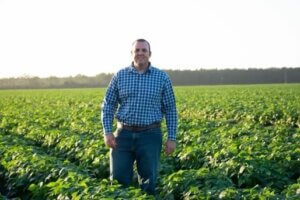
Good science depends on real-world conditions for our experiments. It’s real at Ben Wells Produce north of Hastings. Ben produces chipping and table potatoes. Like all of agriculture, it’s a tough business.

So for him to take a portion of his acreage out of commercial production, allow scientists free passage onto his property and trust them with data from his fields is an invaluable contribution to science. It gets us much closer to your reality, the conditions you work under, than the experiments we conduct on a UF/IFAS research farm where scientists control so many factors and make all the decisions.

The support of Wells has advanced our work, especially on phosphorus rates on potatoes. Zotarelli, a professor in our Horticultural Sciences Department says industry partners like Wells provide the opportunity to demonstrate the effectiveness of our research under real-world conditions.
The team of scientists have all visited the Wells plot regularly, keeping him informed and coordinating operations so that commerce and science don’t collide. After all, the science is supposed to support your bottom line, not take away from it.

But that relationship, like all relationships, is built over time. The UF/IFAS through the Hastings Agricultural Extension Center has worked with Ben and his father for more than a decade. Wells, alongside other growers, has loaned his land, provided letters of support for research grants, and offered his wisdom and feedback on the work done on his plots.

He knows we come to discover, not to dictate. Indeed, in our most recent report to the Florida Department of Agriculture and Consumer Services, we state that the purpose of the research is to: “…achieve maximum yield and quality goals of the grower while doing so in a manner that minimizes nutrient inefficiencies to the environment.”

That trust is not only a foundation of good science, it’s a way to get it done as fast as possible. We didn’t have to spend months looking for a potato grower willing to host trials. All those Farm Bureau meetings, past partnerships, field days at Hastings, ag tours, and, of course, phone calls, made it obvious to Christian that he needed to call Ben.

It gave Ben the confidence to take that phone call, hear what the scientist had to say, and let him know it was OK to come on over and start planting—again.

UF/IFAS scientists are doing the research to protect your profit and the planet. So, in a way, is Ben. I thank him for his vital role in our science, and I hope you will, too.

Scott Angle is the University of Florida’s Senior Vice President for Agriculture and Natural Resources and leader of the UF Institute of Food and Agricultural Sciences (UF/IFAS).

Land Grant Partner

June 2023 FloridAgriculture eNewsletter

dr angleBy J. Scott Angle
[email protected]
@IFAS_VP

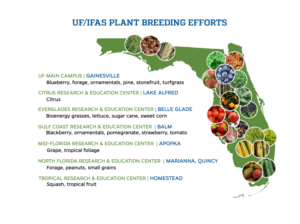
You get first shot at the latest blueberry varieties developed in Gainesville, strawberries from Balm, peanuts from Marianna, forages tested in Ona, tropical foliage from Apopka, sweet corn from Belle Glade and squash from Homestead.

The common thread running through this tapestry of discovery is the Florida Foundation Seed Producers (FFSP). John Beuttenmuller and his team make sure that our innovation machine runs for you.

FFSP works closely with the UF/IFAS plant breeding team on cultivars that thrive under Florida conditions. When those varieties are ready for release, Florida farmers get the opportunity to use them, generally years ahead of international competitors.

Meanwhile, when that head start plays out and you’re moving on to new varieties, FFSP eventually licenses cultivars abroad to protect its intellectual property, and they reinvest that money into Florida-focused innovation. 
It’s hard to imagine that we’d have a new blueberry lab in Gainesville without this revenue stream. You’re getting an innovation factory for the next discovery funded in significant part from royalties from the last breakthrough. 

FFSP licensing royalties have also been used to build greenhouses for our strawberry breeding team. And one of the high-profile gifts of our last capital campaign was the establishment of the FFSP Plant Breeding Endowment. It sets up a friendly competition to find the most potentially impactful new breeding projects at UF and brings in representatives from industry to pick which ones to fund.

FFSP does more than promote new versions of old standbys. It is central to the search for the next new Florida crop. Namely, it’s been a prime sponsor of 33 projects aimed at figuring out if enterprises ranging from barley to vanilla, olives to vegetable high tunnels, are the best bet for a new commercially viable commodity. 
And now that we’ve got 15 new faculty with expertise in artificial intelligence, we need to jumpstart their work. FFSP helped light the fuse by providing much of the funding to bring together 11 teams around projects ranging from accelerated precision plant breeding to automated strawberry yield protection. We expect AI technologies, licenses and startup companies to result.

Beuttenmuller is a friend of the Farm Bureau. He sits on your Peanut and Cotton Advisory Committee. He’s long made sure Farm Bureau is represented on his FFSP board. Nate Jameson, whose wife Anna is on the Sumter County Farm Bureau board, is FFSP’s board vice president. Kevin Morgan served on the board until his retirement as assistant to the former Farm Bureau president. Another former FFBF administrator, Jaime Jerrells, served on the FFSP board and continues to do so in her new role for the commissioner of agriculture.

Beuttenmuller is a great example of someone who helps ensure that UF/IFAS innovation is relevant to Florida farmers by actually getting it into your hands through commercialization. 

New crop varieties are intellectual property. By protecting that property, Beuttenmuller and FFSP are protecting Florida agriculture. 

Scott Angle is the University of Florida’s Senior Vice President for Agriculture and Natural Resources and leader of the UF Institute of Food and Agricultural Sciences (UF/IFAS).

Your Land Grant Partner

May 2023 FloridAgriculture eNewsletter

dr angleBy J. Scott Angle
[email protected]
@IFAS_VP

In a state where Farm Bureau members are so good at producing just about any kind of food, it’s bewildering that we import upwards of 80 percent of our seafood.

I believe we’re at a moment where we have the potential to change that. The latest USDA Dietary Guidelines for Americans basically call on us to double our seafood consumption. How are we going to meet the demand if Americans actually act on this advice? The shutdown of wild harvesting of oysters in Apalachicola Bay makes this an even heavier lift.

Leslie Sturmer of UF/IFAS Extension and the UF/IFAS Nature Coast Biological Station, who has a history of helping turn fishers into farmers, believes we can still be a great oyster-producing state, and we can do it through oyster farming.

Three years ago the UF/IFAS research office set up a starter fund to incentivize investigation into what it calls emerging enterprises, and Sturmer’s oyster work was one of the first projects it funded.

Sturmer built on that early funding and is currently seeking ways to reduce oyster mortality by working with oyster farmers in the Pensacola Bay, Indian River Lagoon, Alligator Harbor, Oyster Bay, and Mosquito Lagoon as well as Apalachicola Bay.

More recently, we launched another starter fund aimed at developing applications of artificial intelligence to help farmers, and again seafood made the list. Aquaculture scientist Huiping Yang has teamed up with two of our recent faculty hires with expertise in AI in hopes of accelerating the breeding of new improved hard clam varieties.

That kind of partnering of scientists is essential to finding solutions to complex challenges.

So is partnering with stakeholders. That’s why Sturmer serves as technical adviser to the Florida Farm Bureau Federation’s Aquaculture Advisory Committee.

Matt DiMaggio, the new director of the UF/IFAS Tropical Aquaculture Lab in Ruskin, does as well. DiMaggio has big plans to expand the Lab’s traditional portfolio focused on ornamental fish to include food fish. I like his plan and intend to support the additional scientists needed as I can find the resources to do so.

Aquaculture doesn’t always have to mean shooting for the center of the plate. We have scientists investigating how to grow coral as a way to restore ecosystems. We’ve looked at baitfish. We even have a biogeochemist working on the prospects for harvesting seaweed.

She sees potential for seaweed as an ingredient in cattle feed that would reduce the animals’ methane emissions.

But we have to do more than see whether it can be done. We need to know if can be done profitably. That’s why we economists Bachir Kassas, John Lai, and Andrew Ropicki of the Food and Resource Economics Department exploring whether consumers would pay more for milk and beef with a smaller carbon footprint, the kind you might get from seaweed-fed cows.

Among our existing fin fish aquaculture research is the work of Cortney Ohs at our Indian River Research and Education Center on how to raise hogfish in tanks as potential food fish. We also recently promoted Leonardo Ibarra-Castro at the UF Whitney Lab in St. Augustine to work on red snapper, snook and red drum.

Ropicki again is also our connection to an exciting company growing delicious, and environmentally friendly Atlantic salmon right here in Florida. As we continue to build on our expertise in fin fish as food, we’ve turned to Atlantic Sapphire.

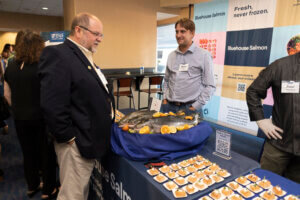
Atlantic Sapphire showcasing its Florida farm-raised salmon at the UF/IFAS Flavors of Florida event in March 2023.

I can attest to the quality of the product. One of the notable foods at our recent Flavors of Florida showcase of locally produced products was Atlantic Sapphire’s Bluehouse Salmon grown in Homestead.

Company leaders have also come to campus to give a seminar on their experience on the frontier of fin fish farming in Florida. Florida Sea Grant and Ropicki are currently helping to arrange internships at the company. To grow fish in Florida, we’ll have to grow the talent to do it.

J. Scott Angle is the University of Florida’s Senior Vice President for Agriculture and Natural Resources and leader of the UF Institute of Food and Agricultural Sciences (UF/IFAS).


Meaningful Steps

March 2021 FloridAgriculture eNewsletter

By J. Scott Angle
[email protected]
@IFAS_VP

I’m nearly halfway through fulfilling a pledge to visit all 67 UF/IFAS county Extension offices. One way I gauge the effectiveness of an office’s outreach—which is, after all, its mission—is whether I get to meet the county Farm Bureau president.

David Hafner (L) and Dr. Angle

Martin County Farm Bureau President David Hafner offered an important endorsement of our service to stakeholders just by showing up when my road tripping took me to Stuart last month. Then he impressed me more when we got to talk.

He’s concerned about his own operation. Cattle wasn’t working for him, so he’s shifted exclusively to small livestock—poultry, pigs and goats. He talked a lot less about his own operation, though, than yours.

By his own reckoning, Hafner is more advocate than farmer.

Hafner came to meet me at the UF/IFAS Extension Martin County office, and he also made time to hear me via Zoom at the October meeting with the Council of Presidents, because he cares about Florida agriculture and because he cares about UF/IFAS support for it.

That support goes two ways. Like many county presidents, in most years he goes to Tallahassee many years to advocate on behalf of agriculture, and he told me that his elevator pitch when he gets a legislator’s ear is about support for the UF/IFAS budget. Again, he’s choosing service over self-interest.

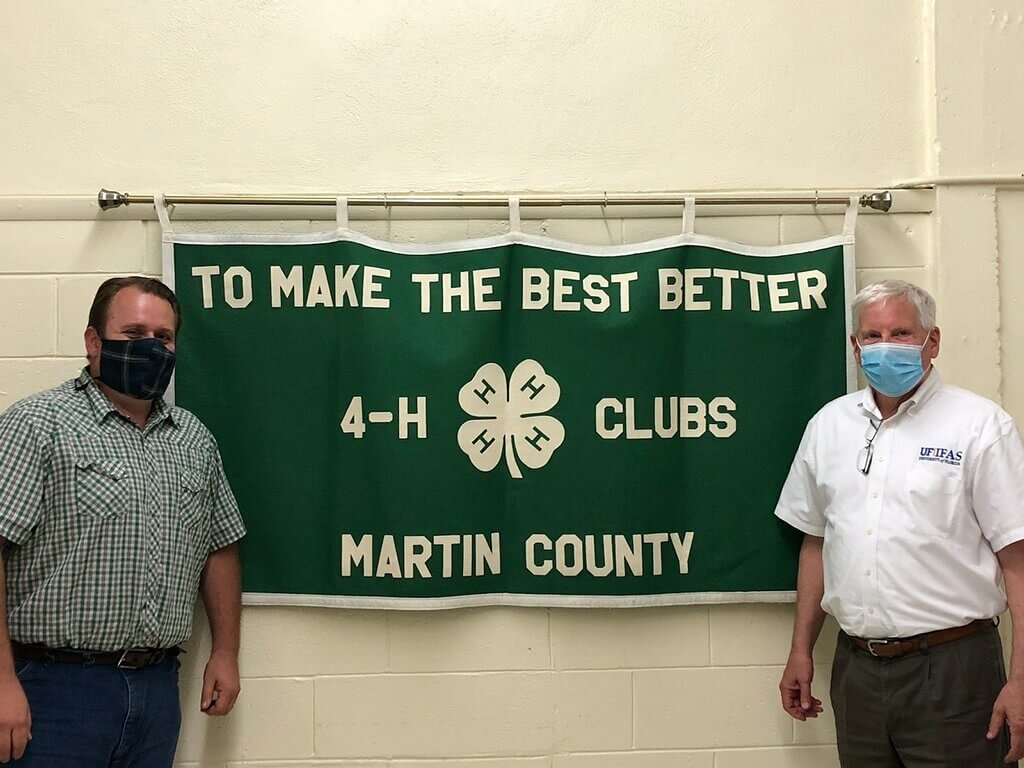
It won’t put any more money in his pocket, but it could put more in yours. A strong UF/IFAS-Farm Bureau partnership is essential to the greater good of Florida agriculture. That’s not just me and President Hoblick. That’s 67 county Farm Bureau presidents and 67 county Extension directors. Just to see Hafner with UF/IFAS Extension Martin County Director Jennifer Pelham told me they understand this. Hafner’s only been president since October, so they’re still building a relationship. Small first steps are meaningful, like Hafner inviting Pelham to deliver a state of UF/IFAS message at his board meetings.

Hafner in turn serves on Pelham’s Sustainability and Commercial Horticulture Advisory Committee to give stakeholder input into Extension programming. And as if he didn’t do enough volunteering for the good of today’s Florida agriculture, he’s also hard at work on its future serving on the local 4-H Advisory Committee.

4-H is where we connected most deeply, for it is a subject dear to both of us. Hafner grew up in 4-H, so he knows firsthand its impact. It certainly succeeded in creating a Martin County leader.

What Hafner’s loyalty also demonstrates is that you reward us not just with political support, but with the relationships and trust that are essential to the dissemination of science that makes farming more profitable, efficient and sustainable.

I’m pleased to see that Pelham and her team are earning that trust. I want to earn it, too. Reach out to me, even if you’re far from Gainesville. I want to meet you, whether it’s at your farm, at the Florida Farm Bureau annual meeting in October, or at your local Extension office.

Scott Angle is the University of Florida’s Vice President for Agriculture and Natural Resources and leader of the UF Institute of Food and Agricultural Sciences (UF/IFAS).