Tag Archives: UF/IFAS

Your Land Grant Partner

September 2023 FloridAgriculture eNewsletter

dr angleBy J. Scott Angle
[email protected]
@IFAS_VP

It was music to my ears to hear District 17 State Director Mark Sodders talk about how UF/IFAS keeps him in business. It was comedy to hear District 5 State Director Rod Land say of Lafayette County: “That’s where you go when you die… if you’re good!”

And it was poetry to hear President Jeb Smith talk about the strong bonds between UF/IFAS and the Florida Farm Bureau.

I’m proud to serve the university as interim provost, but as I told the gathering at the Extension Professional Associations of Florida annual Farm Bureau appreciation dinner last month, I’m eager to get back to leading UF/IFAS full time.

It’s not like I needed a reminder of why, but the dinner at the Alachua County Extension Office in Newberry reconnected me with friends new and old and drove home the sense of community and kinship I feel with Farm Bureau folks.

From Jeb’s bear hug to talking fertilizer with Mark to meeting a number of the Farm Bureau’s communiGators—the corps of recent UF grads who help Rachael Smith tell the Florida ag story, I felt at home.
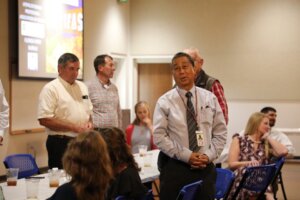
I was enthused by District 19 State Director Mark Wilson’s interest in artificial intelligence in agriculture. Women’s Leadership Committee Chair Danielle Daum prompted an important discussion about broadening our thinking about qualifications as we recruit professionals for Extension positions.

It’s going to be tougher to escape the administration building unnoticed if I do an overnight in Orlando rather than just an after-hours local visit like the one in Newberry. Still, I hope to see you all at the annual meeting at the Caribe Royale.

It’ll be worth the trip just to see you honor the Extension Professional of the Year. But I know it will also include the mix of music, comedy and poetry I’ve come to expect from visits with FFBF, that sense of kinship and community.
I work for you. Thanks for making it feel like a family business.

Scott Angle is the University of Florida’s Interim Provost. Since 2020 he has served as UF’s Senior Vice President for Agriculture and Natural Resources and leader of the UF Institute of Food and Agricultural Sciences (UF/IFAS).

Land Grant Partner

August 2023 FloridAgriculture eNewsletter

dr angleBy J. Scott Angle
[email protected]
@IFAS_VP

Thanks in part to Farm Bureau support for our legislative agenda, UF/IFAS plans to expand its enrollment in equine programs by 10 percent.

This will prepare more students for work in farm management, pharmaceutical and feed sales, equine business marketing or to apply for veterinary school or other advanced degrees. It means more hands-on, experiential learning.

The funding means we can begin to lift limitations we’ve had on instruction in how to take care of the animals that help take care of your animals because the “classroom” had slipped into disrepair.

The state will fund nearly $2 million for a new building and assorted repairs to the UF/IFAS Horse Teaching Unit, aka the HTU.

The current facilities become unusable when rain floods the property. Classes get canceled, research gets disrupted. Holes, unsafe wiring and fire hazards threaten the safety of animals and humans alike.

During the winter, Florida has more horses than Kentucky. Yet there’s nowhere else in the entire Florida public university system I know of where a student can take Techniques in Farrier Science or live at a stable to take on 24/7 care of these valuable animals.

So the upgrade of the HTU is important not only to support the huge economic impact of equine competitions and tourism but of training your future professionals.

This is not a case of remedying neglect. We’ve stretched the resources we have as far as they’ll go.

I’d like to single out the outstanding job that Angela Chandler has done. She’s so good at managing the HTU that when the director of our Equine Sciences Center in Ocala retired, we gave Chandler a second job and used the savings to, among other things, pay for needed repairs.

Chandler (who is quick to credit Joel McQuagge and Saundra TenBroeck for building the program) also boosted hay production at the Ocala center, reducing feed costs at the equine and beef units. She’s saved money through equipment sharing, and she’s built a reputation for the HTU that has the potential to generate revenue through standing outside stallions.

Indeed, last year the university recognized her among its tens of thousands of employees statewide with one of its eight Superior Accomplishment Awards.

The Farm Bureau’s annual day in Tallahassee did a lot to educate policy makers about the need. Now that we have some of the resources to address it, I hope you’ll join me in thanking Representative Josie Tomkow and Senator Dennis Baxley for sponsoring the legislation to authorize the funding.

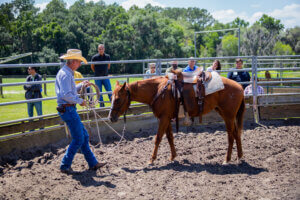
Joel McQuagge training a horse in a demonstration at the Horse Teaching Unit. Photo taken 05-15-19  

UF/IFAS is also launching a fundraising campaign to build an endowment to support the equine program, a critical component of its long-term success. If you’re interested in naming rights or other opportunities to support the program, please contact Julie Conn at [email protected].

With all the technology we’re bringing you to reduce manual labor and better inform your management decisions, we can’t outright replace the horse.

That four-legged tool is only as effective as its operator, though. The HTU is how we transmit the know-how for you to get the most out of your horses and ensure they get the same care your cattle receive on your ranch.

As the HTU improves, so does the student experience, and so does the quality of the graduates you hire.

Scott Angle is the University of Florida’s Interim Provost and will return as Senior Vice President for Agriculture and Natural Resources and leader of the UF Institute of Food and Agricultural Sciences (UF/IFAS).


Your Land Grant Partner

July 2023 FloridAgriculture eNewsletter

dr angleBy J. Scott Angle
[email protected]
@IFAS_VP

When Florida agriculture and UF/IFAS identified a sudden and emergency need to update nutrient rate recommendations, we turned to a longstanding relationship—Farm Bureau members and UF/IFAS scientists.

The Farm Bureau leader is Ben Wells, vice president of the Putnam/St. Johns County Farm Bureau. The team of UF/IFAS scientists includes Christian Christensen, Lincoln Zotarelli, Lakesh Sharma, Kelly Morgan, David Liu, Tom Obreza, and others.

We never intended for our recommendations—some of which are decades old—to become regulations. But that’s where we are. So we’re doing the research on how much fertilizer goes on crops that include potatoes, tomatoes, citrus, corn, green beans, and more.

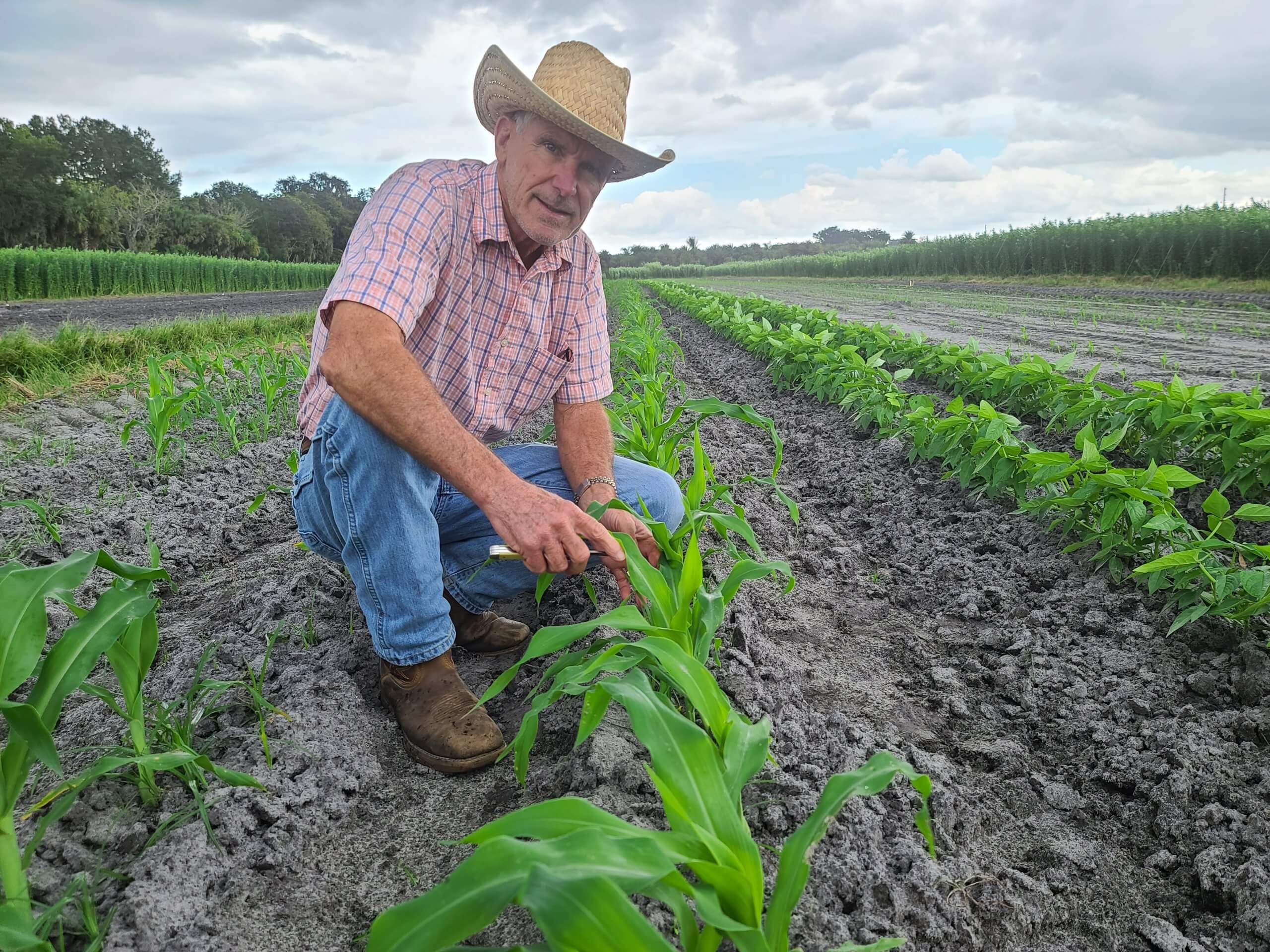
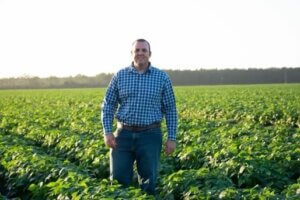
Good science depends on real-world conditions for our experiments. It’s real at Ben Wells Produce north of Hastings. Ben produces chipping and table potatoes. Like all of agriculture, it’s a tough business.

So for him to take a portion of his acreage out of commercial production, allow scientists free passage onto his property and trust them with data from his fields is an invaluable contribution to science. It gets us much closer to your reality, the conditions you work under, than the experiments we conduct on a UF/IFAS research farm where scientists control so many factors and make all the decisions.

The support of Wells has advanced our work, especially on phosphorus rates on potatoes. Zotarelli, a professor in our Horticultural Sciences Department says industry partners like Wells provide the opportunity to demonstrate the effectiveness of our research under real-world conditions.
The team of scientists have all visited the Wells plot regularly, keeping him informed and coordinating operations so that commerce and science don’t collide. After all, the science is supposed to support your bottom line, not take away from it.

But that relationship, like all relationships, is built over time. The UF/IFAS through the Hastings Agricultural Extension Center has worked with Ben and his father for more than a decade. Wells, alongside other growers, has loaned his land, provided letters of support for research grants, and offered his wisdom and feedback on the work done on his plots.

He knows we come to discover, not to dictate. Indeed, in our most recent report to the Florida Department of Agriculture and Consumer Services, we state that the purpose of the research is to: “…achieve maximum yield and quality goals of the grower while doing so in a manner that minimizes nutrient inefficiencies to the environment.”

That trust is not only a foundation of good science, it’s a way to get it done as fast as possible. We didn’t have to spend months looking for a potato grower willing to host trials. All those Farm Bureau meetings, past partnerships, field days at Hastings, ag tours, and, of course, phone calls, made it obvious to Christian that he needed to call Ben.

It gave Ben the confidence to take that phone call, hear what the scientist had to say, and let him know it was OK to come on over and start planting—again.

UF/IFAS scientists are doing the research to protect your profit and the planet. So, in a way, is Ben. I thank him for his vital role in our science, and I hope you will, too.

Scott Angle is the University of Florida’s Senior Vice President for Agriculture and Natural Resources and leader of the UF Institute of Food and Agricultural Sciences (UF/IFAS).

Your Land Grant Partner

May 2023 FloridAgriculture eNewsletter

dr angleBy J. Scott Angle
[email protected]
@IFAS_VP

In a state where Farm Bureau members are so good at producing just about any kind of food, it’s bewildering that we import upwards of 80 percent of our seafood.

I believe we’re at a moment where we have the potential to change that. The latest USDA Dietary Guidelines for Americans basically call on us to double our seafood consumption. How are we going to meet the demand if Americans actually act on this advice? The shutdown of wild harvesting of oysters in Apalachicola Bay makes this an even heavier lift.

Leslie Sturmer of UF/IFAS Extension and the UF/IFAS Nature Coast Biological Station, who has a history of helping turn fishers into farmers, believes we can still be a great oyster-producing state, and we can do it through oyster farming.

Three years ago the UF/IFAS research office set up a starter fund to incentivize investigation into what it calls emerging enterprises, and Sturmer’s oyster work was one of the first projects it funded.

Sturmer built on that early funding and is currently seeking ways to reduce oyster mortality by working with oyster farmers in the Pensacola Bay, Indian River Lagoon, Alligator Harbor, Oyster Bay, and Mosquito Lagoon as well as Apalachicola Bay.

More recently, we launched another starter fund aimed at developing applications of artificial intelligence to help farmers, and again seafood made the list. Aquaculture scientist Huiping Yang has teamed up with two of our recent faculty hires with expertise in AI in hopes of accelerating the breeding of new improved hard clam varieties.

That kind of partnering of scientists is essential to finding solutions to complex challenges.

So is partnering with stakeholders. That’s why Sturmer serves as technical adviser to the Florida Farm Bureau Federation’s Aquaculture Advisory Committee.

Matt DiMaggio, the new director of the UF/IFAS Tropical Aquaculture Lab in Ruskin, does as well. DiMaggio has big plans to expand the Lab’s traditional portfolio focused on ornamental fish to include food fish. I like his plan and intend to support the additional scientists needed as I can find the resources to do so.

Aquaculture doesn’t always have to mean shooting for the center of the plate. We have scientists investigating how to grow coral as a way to restore ecosystems. We’ve looked at baitfish. We even have a biogeochemist working on the prospects for harvesting seaweed.

She sees potential for seaweed as an ingredient in cattle feed that would reduce the animals’ methane emissions.

But we have to do more than see whether it can be done. We need to know if can be done profitably. That’s why we economists Bachir Kassas, John Lai, and Andrew Ropicki of the Food and Resource Economics Department exploring whether consumers would pay more for milk and beef with a smaller carbon footprint, the kind you might get from seaweed-fed cows.

Among our existing fin fish aquaculture research is the work of Cortney Ohs at our Indian River Research and Education Center on how to raise hogfish in tanks as potential food fish. We also recently promoted Leonardo Ibarra-Castro at the UF Whitney Lab in St. Augustine to work on red snapper, snook and red drum.

Ropicki again is also our connection to an exciting company growing delicious, and environmentally friendly Atlantic salmon right here in Florida. As we continue to build on our expertise in fin fish as food, we’ve turned to Atlantic Sapphire.

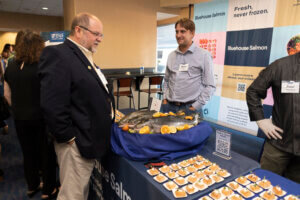
Atlantic Sapphire showcasing its Florida farm-raised salmon at the UF/IFAS Flavors of Florida event in March 2023.

I can attest to the quality of the product. One of the notable foods at our recent Flavors of Florida showcase of locally produced products was Atlantic Sapphire’s Bluehouse Salmon grown in Homestead.

Company leaders have also come to campus to give a seminar on their experience on the frontier of fin fish farming in Florida. Florida Sea Grant and Ropicki are currently helping to arrange internships at the company. To grow fish in Florida, we’ll have to grow the talent to do it.

J. Scott Angle is the University of Florida’s Senior Vice President for Agriculture and Natural Resources and leader of the UF Institute of Food and Agricultural Sciences (UF/IFAS).


Meaningful Steps

March 2021 FloridAgriculture eNewsletter

By J. Scott Angle
[email protected]
@IFAS_VP

I’m nearly halfway through fulfilling a pledge to visit all 67 UF/IFAS county Extension offices. One way I gauge the effectiveness of an office’s outreach—which is, after all, its mission—is whether I get to meet the county Farm Bureau president.

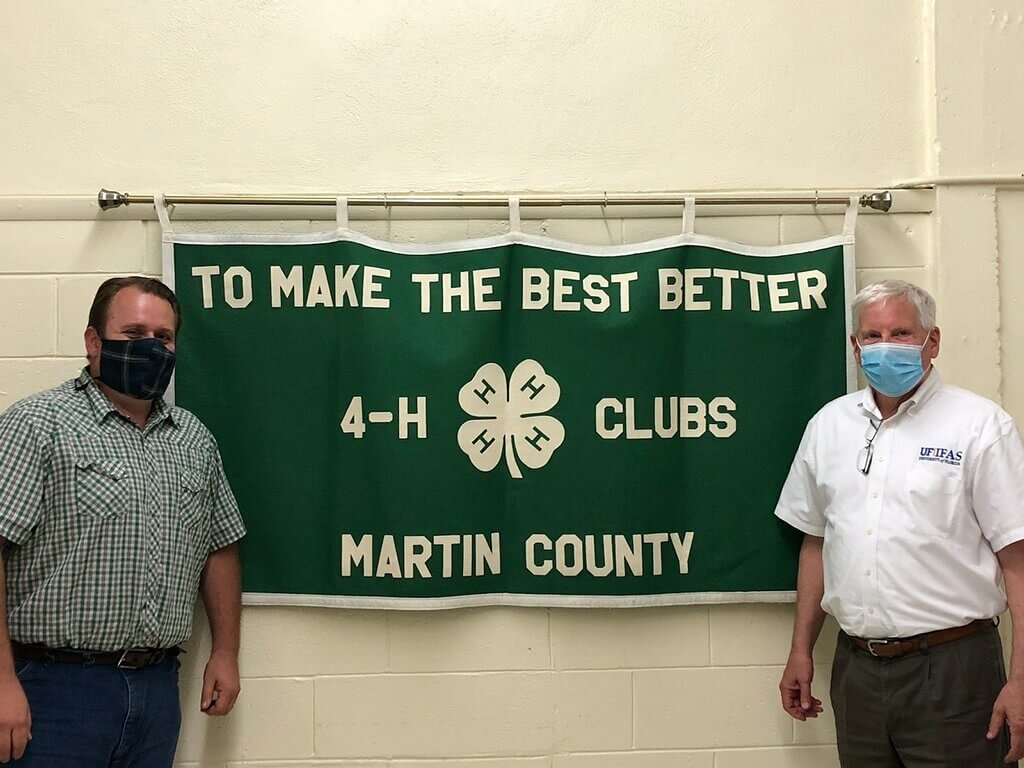
David Hafner (L) and Dr. Angle

Martin County Farm Bureau President David Hafner offered an important endorsement of our service to stakeholders just by showing up when my road tripping took me to Stuart last month. Then he impressed me more when we got to talk.

He’s concerned about his own operation. Cattle wasn’t working for him, so he’s shifted exclusively to small livestock—poultry, pigs and goats. He talked a lot less about his own operation, though, than yours.

By his own reckoning, Hafner is more advocate than farmer.

Hafner came to meet me at the UF/IFAS Extension Martin County office, and he also made time to hear me via Zoom at the October meeting with the Council of Presidents, because he cares about Florida agriculture and because he cares about UF/IFAS support for it.

That support goes two ways. Like many county presidents, in most years he goes to Tallahassee many years to advocate on behalf of agriculture, and he told me that his elevator pitch when he gets a legislator’s ear is about support for the UF/IFAS budget. Again, he’s choosing service over self-interest.

It won’t put any more money in his pocket, but it could put more in yours. A strong UF/IFAS-Farm Bureau partnership is essential to the greater good of Florida agriculture. That’s not just me and President Hoblick. That’s 67 county Farm Bureau presidents and 67 county Extension directors. Just to see Hafner with UF/IFAS Extension Martin County Director Jennifer Pelham told me they understand this. Hafner’s only been president since October, so they’re still building a relationship. Small first steps are meaningful, like Hafner inviting Pelham to deliver a state of UF/IFAS message at his board meetings.

Hafner in turn serves on Pelham’s Sustainability and Commercial Horticulture Advisory Committee to give stakeholder input into Extension programming. And as if he didn’t do enough volunteering for the good of today’s Florida agriculture, he’s also hard at work on its future serving on the local 4-H Advisory Committee.

4-H is where we connected most deeply, for it is a subject dear to both of us. Hafner grew up in 4-H, so he knows firsthand its impact. It certainly succeeded in creating a Martin County leader.

What Hafner’s loyalty also demonstrates is that you reward us not just with political support, but with the relationships and trust that are essential to the dissemination of science that makes farming more profitable, efficient and sustainable.

I’m pleased to see that Pelham and her team are earning that trust. I want to earn it, too. Reach out to me, even if you’re far from Gainesville. I want to meet you, whether it’s at your farm, at the Florida Farm Bureau annual meeting in October, or at your local Extension office.

Scott Angle is the University of Florida’s Vice President for Agriculture and Natural Resources and leader of the UF Institute of Food and Agricultural Sciences (UF/IFAS).


Be the Voice. Live the Legacy

October FloridAgriculture eNewsletter

Rex Clonts, Seminole County Farm Bureau President

Fifth generation Floridian, Rex Clonts, comes from a long line of vegetable farmers in Central Florida. He and his wife, Denise, own and operate “BigDaddy’s Farm,” named after Rex’s grandfather, in Seminole County.

BigDaddy’s Farm raises over 80 different vegetables and flowers for their 300-member Community Organized Agriculture (CSA) as well as restaurant sales and other outlets in Central Florida. In addition, Rex and Denise are very excited about the success of their newest venture of growing diversified vegetables for the locally grown organic market.

“The look on our neighbors’ faces each week when they get their vegetable boxes is priceless,” he exclaimed. “It was raised in that field right over there.”

He spent his hot Florida summers working on his family’s farm and couldn’t wait to leave for college to begin a non-agriculture career.

“It didn’t take long for me to realize that my brightest opportunity was taking the farm to the next level, and the older I get, the more passionate I become about the future of Florida agriculture,” he said.

Clonts was elected as the Seminole County Farm Bureau (SCFB) President at the county’s annual meeting last fall and is proud to represent the local organization with more than 2,000 members.

“For over 20 years, Seminole County Farm Bureau has helped sponsor the annual Spring Ranch & Pasture Forum at the Yarborough Ranch in Geneva along with co-sponsors Florida Cattlemen’s Association, UF/IFAS and many others,” Clonts said. “It is held annually on the third Thursday of March; the event is open to the public and is the largest on-ranch educational forum in the state.”

Members of the Yarborough family, along with Central Florida Livestock Agents from UF/IFAS present a program of hands-on training and education in all aspects of cattle ranching including sessions tailored for youth interested in animal care and feeding.

Clonts explained that before COVID-19 derailed the SCFB plans for their county annual meeting, they had planned to hold a showcase of Seminole County agriculture with booths for local farms, nurseries, county Extension, the local forestry division as well as other allied businesses. The event has been rescheduled for the fall of 2021.

President Clonts shared with us that his favorite recipe is collard greens with Italian sausage. “It’s savory, hearty and simple,” he said. Yum!


Looking Back

June FloridAgriculture eNews


[email protected]

By Jack Payne

Jack Payne

Ten years ago, the UF/IFAS beef teaching unit’s structures were condemned as uninhabitable. Our pollinator research headquarters was an oversized closet. We were sifting through what the world had learned about HLB over the previous century and found astonishingly little. We didn’t have the space to gather our Extension corps under one roof for trainings. Our teaching forest headquarters was a pile of ashes.

UF/IFAS was never broken. But there was room for improvement when I got here in 2010. The decade since has been one of remarkable progress for the research and innovation arm of your business.

The UF/IFAS Extension Straughn Professional Development Center came first. With its opening, we no longer had to cram agents into conference rooms, incur ballroom rental expenses, or strategize how to find hundreds of parking spaces in the campus core. We opened an auditorium-sized training center worthy of the men and women who serve you most directly. Just as important, there are more Extension agents to train than there were 10 years ago.

The opening of the Honey Bee Research and Extension Lab propelled us to becoming one of the nation’s leading centers on pollinator expertise. That will make a huge difference for years to come for those of you who grow watermelons, blueberries, squash, cucumbers, cantaloupe and many seed crops.

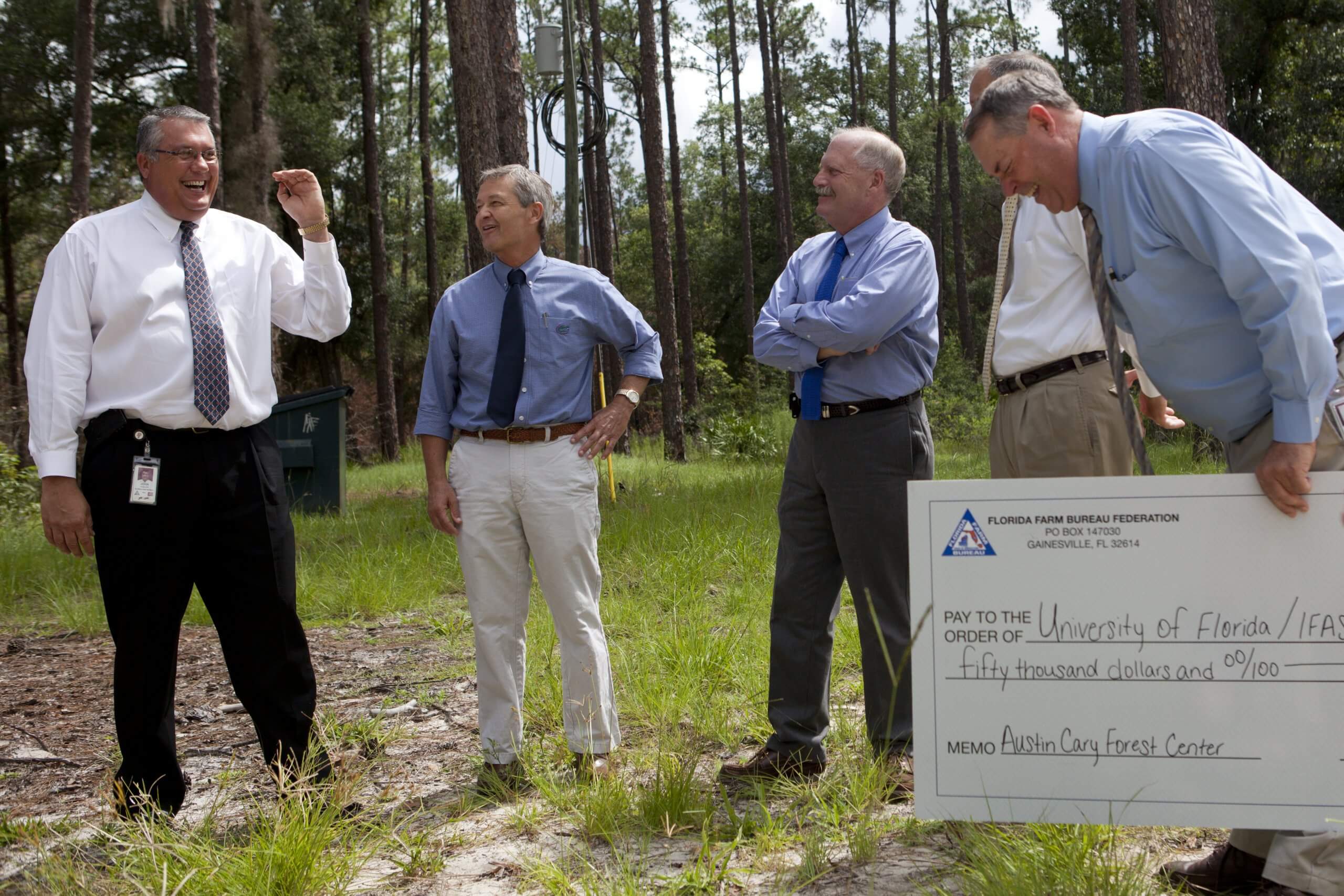
We rebuilt the Beef Teaching Unit so that it’s now equipped to provide training for agriculture teachers, Extension agents, ranchers and 4-H volunteer leaders. Its dormitory immerses future cattle professionals in the experience of caring for animals, not just reading about them. We rebuilt the Austin Cary Forest Roland T. Stern Learning Center, too, thanks in part to Farm Bureau support.

Check presentation toward the rebuilding of the Austin Cary Forest Learning Center on behalf of the Florida Farm Bureau. UF/IFAS Photo by Tyler Jones.

I would argue that we learned more about HLB in the past decade than the rest of the world did in the previous century. Our breakthroughs in nutrition and other management strategies have kept infected groves profitable while we continue to develop citrus varieties that show promise of HLB tolerance.

Speaking of varieties, we added six scientists to our already elite plant breeding team. The team has released 271 cultivars over the past decade. Those are opportunities to grow fruits, vegetables, turf and ornamentals that just weren’t there in 2010.

In fact, during a recent campus lecture, Farm Bureau member Brittany Lee was asked how to save the Florida blueberry industry. UF/IFAS blueberry breeder Patricio Muñoz was in the audience, and Lee looked at him and said, “The solution is Patricio.”

We invested in equipment, land and facilities in Suwannee Valley to turn what had been a demonstration farm into a branch of the North Florida Research and Education Center. Research has accelerated so fast that there’s a waiting list for use of its 400-plus acres.

You can’t be all things to all people, but in a state with 300 commodities you have to try. No matter what your crop is, chances are UF/IFAS is serving you better today than 10 years ago. Chances are, too, that my successor will see room for improvement, and I expect he will someday be able to talk about how much better UF/IFAS is than it was in 2020.

Jack Payne is the University of Florida’s senior vice president for agriculture and natural resources and leader of the Institute of Food and Agricultural Sciences.

Ag Talk with Jack Payne

[email protected]

@JackPayneIFAS

By Jack Payne

Jack Payne

Late last year I called Kenneth Parker to ask a favor. I thought a lot about it before I dialed, because I knew his answer would be yes. It always is.

I needed a new Florida delegate to a national grassroots council that converges on Washington, D.C. to go to bat for land-grant universities. At first Kenneth said he did not know what I was talking about, but that the other two Florida delegates sounded like good company, so count him in.

That is typical Kenneth Parker for you. As Farm Bureau members, you may know him best as former president of the Hillsborough County Farm Bureau and a regular at the annual convention. But Kenneth transcends a single association or commodity. He basically does whatever he can for Florida agriculture.

Florida Ag Expo 2019 held at the at Gulf Coast Research and Education Center (GCREC)

He brings to that service an appreciation for the science that underpins your

success. For years, Kenneth has worked to strengthen the University of Florida’s Institute of Food and Agricultural Sciences and help us understand industry needs.

Just a month or two before he accepted my request to serve as a Council for Agricultural Research, Extension, and Teaching (CARET) delegate, he had agreed to lead one of our stakeholder advisory groups, the Florida Agricultural Council, as its new president. In 2018, he said yes when we asked him to join SHARE Council, which helps garner philanthropic support for UF/IFAS.

Kenneth established early in his tenure as the executive director of the Florida Strawberry Growers Association his continuing support of the association’s commitment to covering the first few years’ salary for a UF/IFAS strawberry breeder with an expertise in genomics.

That allowed us to essentially have Dr. Seonghee Lee audition for the job. He is since become indispensable to Vance Whitaker’s strawberry breeding team.

Kenneth stood up for me at times when I had to make tough decisions. I have publicly acknowledged him in the past, like in 2014 when UF/IFAS honored FSGA as its industry partner of the year.

As I approach retirement, and I reflect on the contributions of our many supporters, Kenneth stands out. Because he did so much, and because he did it with such kindness and gentleness, Kenneth made me want to do my job better.

I will bet Judi Whitson in your Hillsborough County Farm Bureau office would say the same thing. So would the instructors in Plant City. So would the plant breeders in Wimauma. Soon enough, I expect, so will his peers at SHARE, CARET and the Florida Ag Council.

That means they will all do a better job for you.

Jack Payne is the University of Florida’s senior vice president for agriculture and natural resources and leader of the Institute of Food and Agricultural Sciences.

Ag Talk

April 2020 FloridAgriculture e-Newsletter

Jack Payne
Jack Payne

By Jack Payne
[email protected]
@JackPayneIFAS

The Coronavirus doesn’t stop the need to feed. In fact, the run on supermarkets as I wrote this in mid-March demonstrates how demand for food spikes during a crisis.

This is a moment (maybe a months-long “moment”) for agriculture and agricultural science to shine. We have a wealth of experience as few other sectors do in navigating a crisis — natural disasters, climate variability, market fluctuations, freezes, diseases, pests and other threats.

Just as the food supply you deliver is not interrupted by the Coronavirus, neither is the science you rely upon to inform your decisions.

The women and men of UF/IFAS showed extraordinary effort in taking early action to keep the Coronavirus from sidelining science. Their beat-the-clock hustle ensured the continuity of agricultural science before restrictions on travel, public gatherings or even showing up at the office could threaten to shut down their work to sustain Florida agriculture.

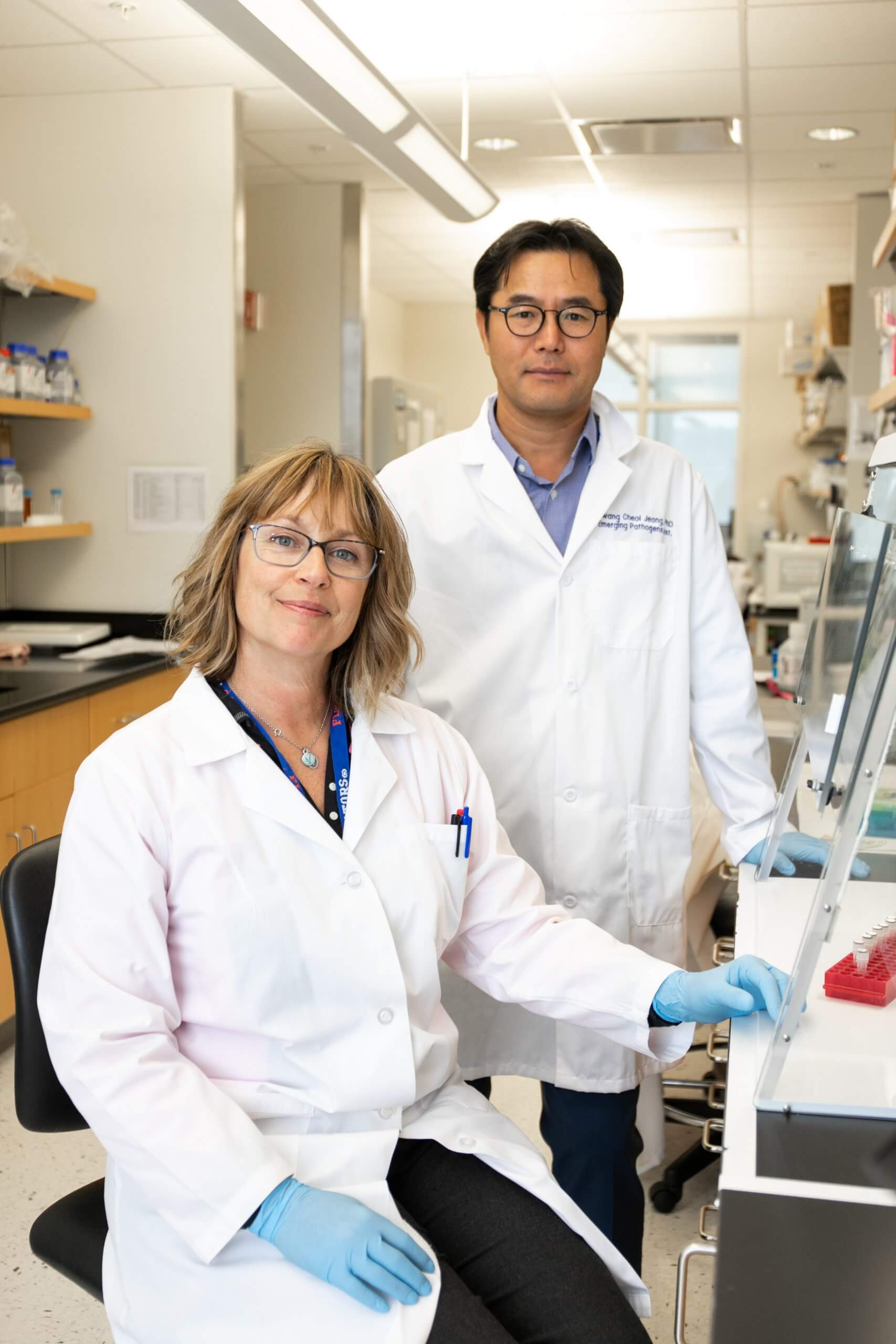
KC Jeong & Samantha Wisely

One of the most extraordinary responses was the darn-near-instant transformation of teaching. Our instructors, administration and instructional technology professionals took classes attended by 6,000 students in the College of Agricultural and Life Sciences and put them all completely online in days. This keeps students on track to graduate on time and prevents gaps in the education they’ll need to be productive 21st century citizens.

These are 6,000 potential future employees. At the very least, they’re 6,000 present and future customers who will be ag ambassadors who can tell friends, family, co-workers, fellow worshippers and strangers where their food comes from.

Lauren Diepenbrock feared that as the movement of people seemingly became more restricted by the hour that her research team would be locked out of an experimental grove by the emergency. So she summoned them to report to the Citrus Research and Education Center by 7 a.m. and got 600 Valencia trees planted in a single day.

She said, “This is work we’ve promised the federal government we’d do to help our growers.” Citrus growers were in crisis long before the Coronavirus, so her research on HLB is too important to face delays caused by Coronavirus. Even a public health emergency didn’t shake her commitment to her pledge to the federal government – or to you.

Vanessa Campoverde showed the same hustle in Extension. When infections began to impact air travel, she jumped in the car and drove six hours from Miami to Live Oak for an important training she needed to help Miami-area producers. She also rushed to squeeze in Spanish-language training for workers who needed to keep their pesticide licenses from expiring during a potential shutdown.

Like so many other things right now, the way we’re delivering agricultural science may look and feel different. Some things don’t change at all, like our commitment to you. We’re still working for you so you can work to feed an anxious world.

Jack Payne is the University of Florida’s senior vice president for agriculture and natural resources and leader of the Institute of Food and Agricultural Sciences.

Session Update

April 2020 e-Newsletter Session Update

The Florida Legislature wrapped up the only remaining business for the 2020 Legislative Session: passing a budget.  Unanimous votes in each chamber sent the largest budget ever to the desk of Gov. Ron DeSantis.

Some general highlights of the $93.2 billion budget include more than $600 million in funding to improve water quality and Everglades projects, $500 million toward teacher pay raises, $100 million for the Florida Forever conservation program and $300 million to respond to the impacts of COVID-19.

Obviously, the effects of COVID-19 will have dramatic impacts on the state’s economy and could force the Legislature to revise the budget in a special session or dip into the $3.8 billion the state has in reserves.

Agriculture Budget Items Close Strong

UF/IFAS

At one point during session, it looked as if UF/IFAS would receive no funding for any of their budget requests as well as lose funding for several recurring projects that were funded in previous years.  But last-minute funding that was added when the Appropriations Chairs met over the weekend.

At the end of the day, the most important request for additional workload dollars was funded at $3.8 million, with $1.7 of that being recurring.  These funds allow UF/IFAS to carry out the essential research and Extension services that agriculture depends on.

The cuts to the existing programs were also restored, meaning that what began as a potential setback year became a significant step forward for UF/IFAS.

FDACS

As we reported last week, budget items for the Florida Department of Agriculture and Consumer Services (FDACS) ended up much better than where they started. The Fresh From Florida program will be fully funded at $5.9 million.  The initial House proposal included a $3.7 million cut. The Rural and Family Lands Program will receive $8.7 million this year after being zeroed out in 2019.  The Office of Ag Water Policy also received funding for eight additional staff that will be integral to implementing provisions of SB 712 requiring BMP verifications.

Other areas of the FDACS budget were sufficiently funded.  Throughout session, there were several proposals to modify the department significantly and how it was funded, but in the end, they were not adopted.

Ask Gov. DeSantis to Sign SB 712: The Clean Waterways Act

This week, we sent out a “Call to Action” urging Gov. DeSantis to sign SB 712, the Clean Waterways Act. This legislation, as mentioned before, was a priority for Farm Bureau this year because it implements a comprehensive, science-based approach to restoring and protecting Florida’s water resources. If you have not done so already, please participate in sending Gov. DeSantis a letter urging him to sign this legislation into law. You can do so at the link below:

https://www.votervoice.net/BroadcastLinks/4jg4clJtSqNOj45I6Yf3MQ

COVID-19 Response

Leadership in the State of Florida is laser-focused on preventing the spread of and mitigating the impacts of Coronavirus, or COVID-19.

Gov. DeSantis has declared a state of emergency, urging all Floridians to avoid gatherings and practice social distancing. As a result, many businesses are closed or working remotely.

Among the many actions taken to mitigate this crisis and assist Floridians in navigating the new normal, Gov. DeSantis issued Executive Order 20-52, which authorized the Florida Department of Transportation to relieve hours of service requirements and the size and weight restrictions for divisible loads on any vehicles transporting emergency equipment, services, supplies and necessary agricultural commodities.

President Designate Releases Video

On Tuesday, March 17, Senate President-Designate Wilton Simpson released a message to Floridians on the importance of Florida agriculture during the COVID-19 pandemic. President-Designate Simpson commended the farmers, ranchers and growers who have remained focused on feeding Floridians and Americans during this time.

Please take a moment to view and share the video: https://www.youtube.com/embed/1aPoLAriLLA

Wrap-up

At the close of the 2020 session, it’s clear that it has been a successful one for Florida Farm Bureau and our partners in the agricultural community.  Protecting the BMP program through additional credibility and additional research was a big victory in SB 712. That bill also effectively stopped a “Rights of Nature” movement that could have significantly increased frivolous lawsuits filed against Florida farms. We also worked to ensure that ag employers could verify employment eligibility through the I-9 process as well as the E-Verify system, helping to relieve additional burdens on our employers.

Successful outcomes in these areas were essential, and we appreciate the Legislature and our members for their hard work to make it happen.

We will continue to keep you updated over the coming weeks as the Governor takes action on bills and the budget and as we look forward to the election cycle.